

Recently, I posted about our new market making business. As a follow-up, I wanted to explain why we decided to focus the business initially on serving clients in the Solana ecosystem.
Several years ago, I wrote a post for the Hummingbot blog called The Thin Crust of Liquidity about how fragmentation across hundreds of crypto exchanges created barren, illiquid markets for everything outside the top coins. Back then (and even today), every new trading venue was an island: separate order books, separate API integrations, separate pools of maker capital. More venues meant thinner liquidity everywhere.
Solana inverts this logic. Because every transaction flows through a single state machine and settles on a single chain, a new DEX doesn't fragment liquidity, but instead becomes a participant in an ongoing, block-by-block auction of the same taker flow. Aggregators route incoming trades across every venue atomically, and the maker with the best price wins the fill.
The result is a deep, vibrant market, not a thin crust. Solana is the deepest, most competitive spot market in crypto, with roughly $2 trillion in spot DEX volume in 2025.
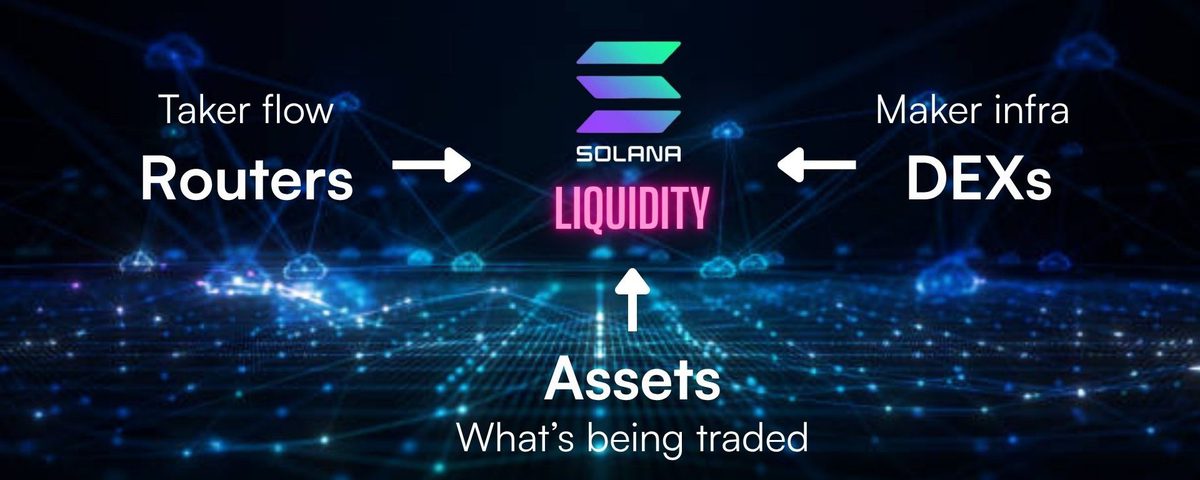
For a new market maker, Solana is the most interesting arena in the world right now. To explain why, here's how I visualize the liquidity landscape:
Liquidity on Solana is a multi-dimensional space. Every trade that happens on the chain can be located along three dimensions:
- Routers: where taker flow enters the system
- DEXs: the maker infrastructure that competes to fill that flow
- Assets: the underlying risk (stablecoin, memecoin, equity, etc) being traded
Let's look at capital flows over time across these different dimensions using Blockworks data.
Routers: the front doors
Approximately 70% of all trading volume of Solana flows through a router (DEX aggregator) such as Jupiter, Titan, DFlow, and OKX DEX Router (Blockworks: % of DEX volume from aggregators). Because they offer a single point of integration for Phantom, Ledger, and other wallets, routers are effectively the front doors to Solana trading. When a user requests a quote and executes it, routers aggregate liquidity from different DEX venues and split each order across whichever combination offers the best execution.
As one of the largest and long-standing applications on the network, Jupiter has long been the top router on Solana. Recently, they have also added their own RFQ system and proprietary Ultra router in addition to aggregating 3rd-party sources.
However, they are facing increasing competition from other routers. DFlow recently partnered with Kalshi to offer direct, atomic access to their prediction markets. Since Jupiter is affiliated with Meteora, Orca has chosen Titan as the default router for swaps on their platform, while OKX's decentralized router has also carved out a meaningful share of the market.
DEXs: maker infrastructure
Since Solana is a single blockchain network, every DEX is really just a different mechanism through which market makers can expose their liquidity to the routers. We can group DEXs into 5 sub-types:
- Public AMM (Raydium Standard, Meteora DAMM, PumpSwap): Based on the original UniswapV2 design, these DEXs allow market makers deposit base and quote assets in constant proportion to provide liquidity
- Public CLMM (Raydium Concentrated, Meteora DLMM, Orca): Based on the UniswapV3 design, these DEXs that allow makers to concentrate their liquidity and create single-sided liquidity positions, enabling greater flexibility and capital efficiency.
- Proprietary AMM (SolFi, HumidiFi, Tessera, BisonFi, ZeroFi, GoonFi): Closed-source programs run by market makers that define a custom liquidity curve for a market. They plug into routers using the same schema as Public AMMs and CLMMs.
- RFQ (JupiterZ, DFlow): Router-operated systems that lets market makers integrate and respond to quotes. Routers generally want makers to integrate into these systems rather than prop AMM, since they can standardize and charge a fee.
- CLOB (Phoenix, Manifest): traditional central limit order books, on-chain.
DEX market share over time shows the maker infrastructure on Solana has matured. In the midst of memecoin mania in 2024, volume was dominated by Raydium, Orca, and Meteora, public AMM and CLMM venues that catered to individual liquidity providers. This started to change in 2025, when propAMMs like SolFi and HumidiFi run by institutional market makers began operation. Afterwards, other institutions started their own propAMMs, while new DEX platforms entered the game. Today, a wide range of DEX platforms, both public and private, engage in cutthroat competition on Solana with no single platform with 20%+ market share.
It's unlikely that any these DEX mechanisms will dominate market share in the future. Public AMMs still own the long tail and price discovery for new Solana tokens like memes and startups, since a prop AMM can't quote an asset that has no external reference price. While prop AMMs and RFQ systems currently own volume for SOL and other majors with an external reference price, CLOBs are starting to clawing back volume on stablecoin and LST pairs. Competition will only increase, and taker flow will keep going wherever execution is best.
Assets: From memes to everything
The third layer of the landscape are the assets being traded. Here, the change has been just as dramatic.
Remember the heady days of 2024 memecoin fever? Pump.fun launched in January 2024 and has hosted almost 12 million token launches since. WIF hit a $4.7 billion market cap, and the frenzy culminated in January 2025 with the TRUMP token, which briefly commanded an $11.7 billion circulating market cap and drove Solana to a then-record $12 billion in DEX volume in a single day.
Back then, Solana was structurally a risky-asset market: retail takers buying volatile tokens from makers who charged wide spreads for holding inventory nobody could hedge. Since then, Solana has matured, especially in terms of the assets being traded. Today, 80% of all trades on Solana are SOL-stablecoin swaps or pure stablecoin swaps.
But if we remove SOL and stables from the asset mix, we can see that this shift was due primarily to Solana's rise as a chain for payments (stablecoin transfers), rather than a complete collapse in demand for risky assets. While trading volume for memes and other risky assets have certainly fallen from their 2024 peaks, they are still robust today at $400 million+ daily. More recently, the rise of ANSEM shows that memes still have legs.
Personally, I'm excited about two other types of assets native to Solana:
- Tokenized equities: While competition from other chains will surely come, currently only Solana has tradeable equity tokens that are directly transferrable to a brokerage via Backpack Securities. In June 2026 tokenized equities comprised nearly 10% of Solana's daily spot DEX volume.
- Ownership coins: tokens with hard-coded governance and legal rights, pioneered by MetaDAO, where the project's IP is assigned to a legal entity and token-holders can raise proposals to liquidate the treasury and returns funds to holders. Notably, ownership coins have exhibited much better post-ICO price performance than VC-backed tokens.
For a new market making firm, this diverse asset mix is extremely compelling, since each asset class requires a different approach in terms of risk management and capital deployment. Memecoins are an inventory-risk game. Stablecoin pairs are a maker infrastructure and spread-compression game measured in fractions of a basis point. Providing liquidity for tokenized equities requires equities data streams and the ability to hedge in off-chain perp and options markets. Ownership coins may entail participating in decision markets and acting like an activist investor.
Every new asset generated on or bridged to Solana creates new trading pairs that need liquidity — and someone has to make those markets.
The frontier keeps moving
Here's the thing that ultimately convinced us to focus Condor Solutions on Solana: the pace of experimentation and innovation at the liquidity layer. Just in the past few weeks, we've seen the following platforms launch:
- JTX: Non-custodial, order book trading platform developed by Jito Labs
- Phoenix: New CLOB perps DEX with fully on-chain order books, launched by Ellipsis Labs
- Manifest: CLOB spot DEX with an innovative seats model and cross-market asset utilization
- GUM: a new Jupiter trading platform that enables cross-chain trading
Any one of these could reshuffle the landscape again. On a wide-open landscape where every venue competes for every fill and new asset types come online continually, market structure evolves in weeks, not decades.
Solana is the best real-time laboratory for market structure that has ever existed, and the market makers who thrive in it will be the ones who can support any asset on any venue without compromising speed and security.
If you're a token issuer, protocol, or exchange navigating the Solana landscape, DM me or contact us.