

XRPLiquid rewards market makers who provide liquidity to eligible RWA markets on the XRP Ledger, backed by a $100,000 initial treasury. Participants earn XRP two ways: trading in supported AMM markets, or running automated order-book strategies with Hummingbot. It's an experimental rewards program sponsored by Ripple Labs — and after a full year of weekly reward epochs, we have enough data to say something meaningful about what liquidity incentives actually do.
65 Epochs by the Numbers
When XRPLiquid launched in April 2025, the first weekly reward pool was 10 XRP. We didn't know whether anyone would show up. The results vastly surpassed our expectations, both in trading volume and in the liquidity the program brought to the XRPL DEX.
Across 65 completed epochs (April 28, 2025 – July 27, 2026):
- $234 million in total trading volume across reward markets
- 3.5 million filled orders
- 55,706 XRP paid out across 65 weekly reward pools
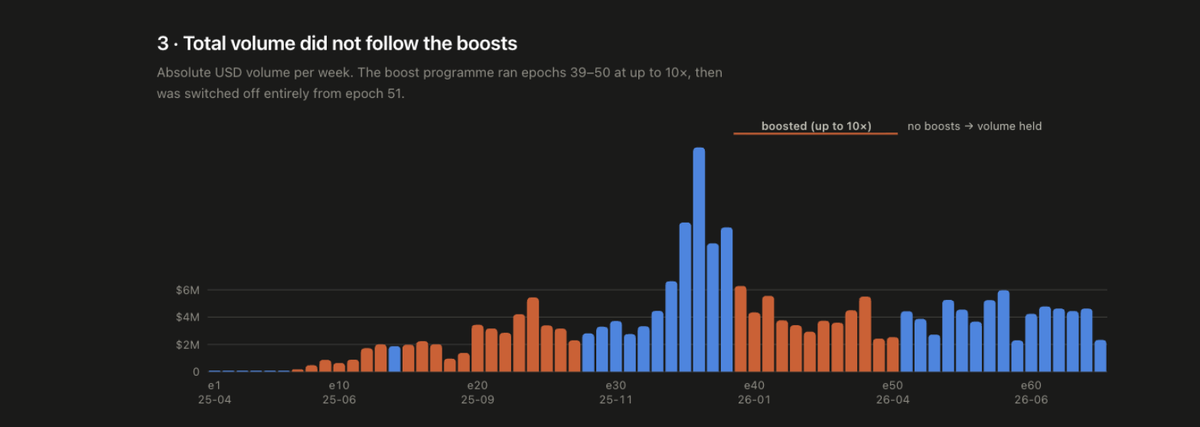
- Weekly volume grew roughly 10x over the life of the program, peaking at $16.4 million in a single week (Epoch 36)
The data also taught us a few things about liquidity incentives on the XRPL:
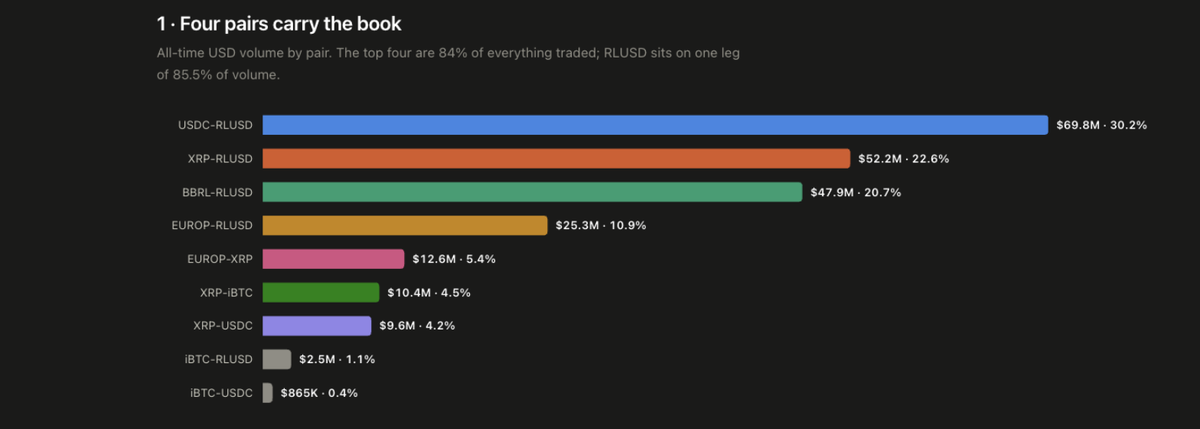
- RLUSD became the hub asset of the program. It sits on one leg of 85.5% of all volume ever traded. USDC-RLUSD (30.2%), XRP-RLUSD (22.6%), and BBRL-RLUSD (20.7%) were the deepest books.
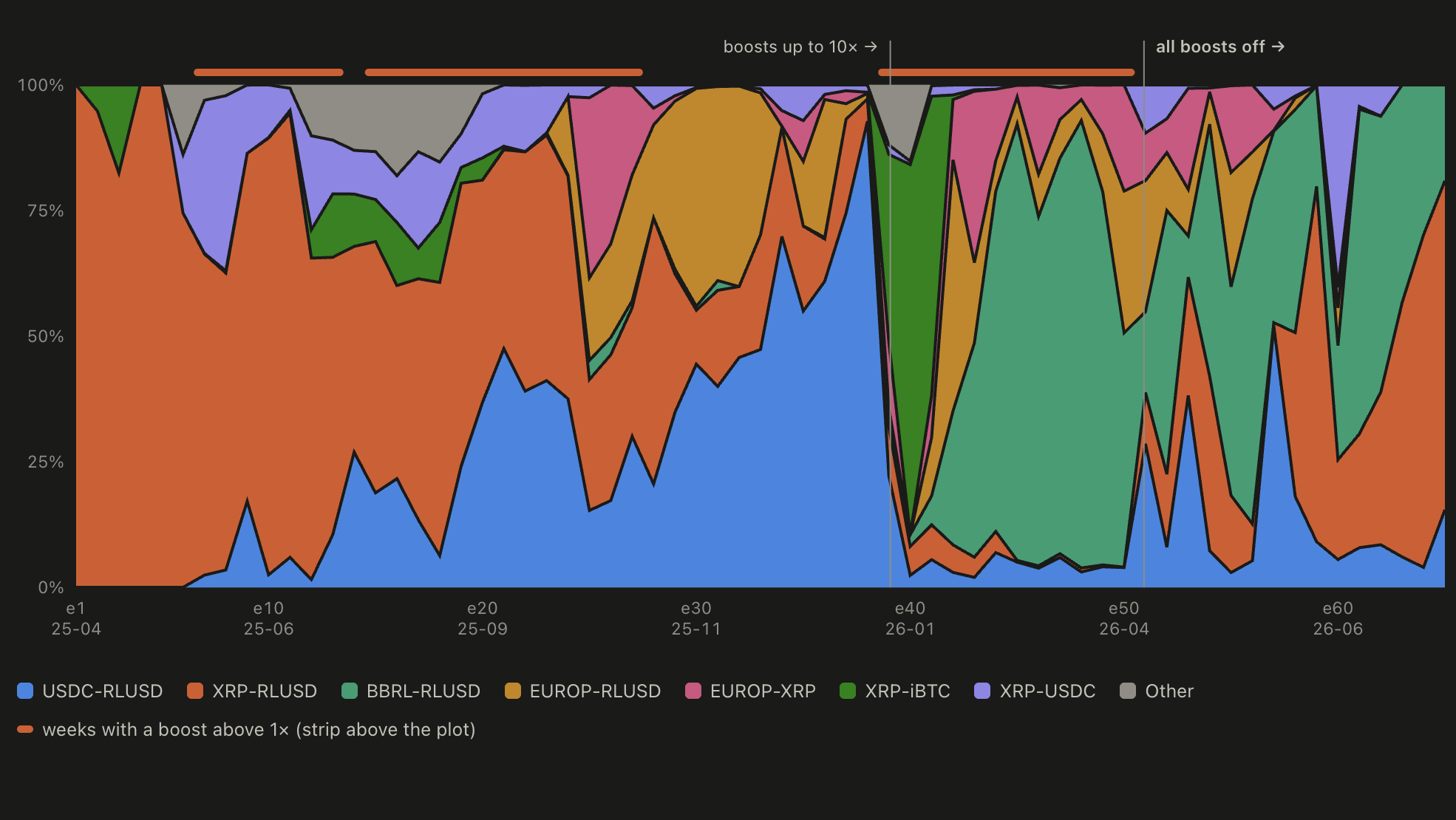
- Boosts are a good launch tool for new markets. Pairs like EUROP-XRP and XRP-iBTC held 2–4% of weekly volume without a boost and jumped past 13% while boosted.
- The liquidity proved durable. When we removed all boosts at Epoch 51, volume shifted back toward the deepest books, and total platform volume went up 9% over the following month.
A closer look at boosts
The cover chart shows every week's volume as 100%, split by pair, with the orange strip marking weeks where at least one pair carried a reward boost above 1×. The boost program ran at up to 10× through epochs 39–50, then was switched off entirely from Epoch 51. Absolute weekly volume tells the same story — the growth trend didn't depend on which weeks were boosted:
A few patterns stand out:
Boosts steer volume between pairs — they don't create it. With BBRL-RLUSD boosted at 10×, it took as much as 72% of weekly volume. Four weeks after every boost was removed, it fell to 32%, and that volume landed on the deepest organic books: USDC-RLUSD (+16.3pp) and XRP-RLUSD (+20.3pp). Total platform volume over the same window went up 9%.
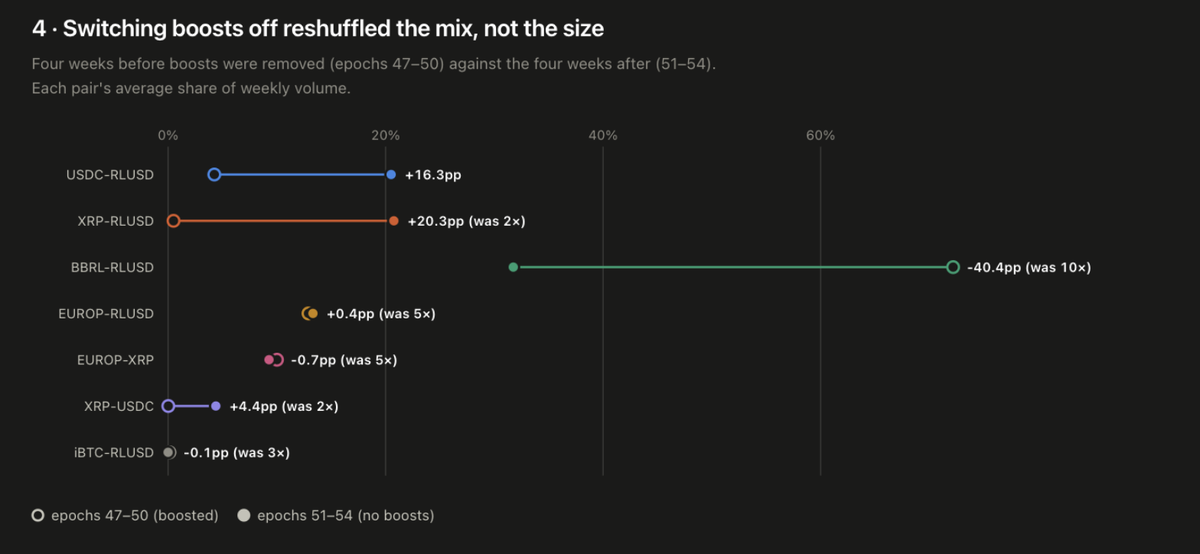
Boosts reliably bootstrap a cold book. EUROP-XRP and XRP-iBTC each held roughly 2–4% of weekly volume unboosted and jumped past 13% while boosted. The effect is real — but it's a launch tool, not a growth lever.
Boosts don't rescue a book with no natural demand. The iBTC pairs sat at 10× for two full epochs and never cleared 2% of weekly volume. Combined, they account for just 1.5% of all-time volume.
Concentration is the steady state. The top four pairs carry 84% of everything ever traded. Incentives moved share between them week to week, but the platform's depth always consolidated back onto the books with real two-sided demand.
What comes next
A year in, the experiment has answered its core question: incentivized communities of individual market makers can bring real, durable liquidity to markets that professional firms ignore. Weekly volume that started with a 10 XRP reward pool now regularly clears eight figures.